Wednesday, August 9, 2017

Rhythm - A powerful medium for honing skills of "special" individuals

I have been fascinated by how rhythm helps in improving skills in individuals with neuro-developmental disabilities such as Autism, intellectual disabilities and Downs Syndrome.  I am convinced that rhythm exercises can make the Neurons work harder and communicate among different parts of the brain, leading to improvements in many faculties.  A case study of how rhythm exercises helped develop 'sense of rhythm' leading to improved quality of tabla playing by a developmentally disabled person is presented in this post.   

It is little more than an year and half I started working with Anand, an intellectually challenged individual, who has been learning Tabla for many years.  We were setting up a music initiative 'Tarang' under Yash Charitable Trust, with Aarti doing vocal, Pratibha playing Sitar and Anand on Tabla.  I have observed that Anand is able to play many 'kayadas' and 'thekhas' of quite a few 'taals'.  When tried to play along with vocal, I could see Anand's struggle.  I felt that the struggle is due to not having a 'sense of rhythm' within.  Because of this, Anand was finding it difficult to sync with the rhythm of singing.  Initially Anand went on playing Tabla, irrespective of what is rendered by the vocalist.  The video clip below (April 2016) demonstrates this.  


To address this problem, we started with rhythm exercises every week, and asked Anand to practice rhythm exercises regularly.  Rhythm being central to any genre of music, and such a powerful medium for enabling different parts of brain, I persisted with rhythm exercises with all the team members of Tarang.  The main objective was to instil the 'sense of rhythm' within the members, especially Anand, as he is playing a percussion instrument.   The first change noticed was, with prompting Anand was able to follow the rhythm of singing for few seconds.  When his attention drops, he loses the rhythm.  

Five months later in September 2016, Anand was able to play Tabla with simple rhythm to a great extent, provided he is prompted by touching his body rhythmically, or showing him the beats while performing.  This improvement is visible in the clip below.


We persisted with rhythm exercises in order to build 'sense of rhythm' within Anand, so that he reaches a stage of playing with vocal by synchronising himself.  Anand progressed steadily and today Anand can sense the rhythm of the same bhajan that Aarti is singing and follow on tabla in sync.  The clip below (taken from a performance on 28th April 2017, in Pune) shows this improvement of Anand.


As Anand could get the beats for the straight rhythm with 'Teen Taal' (Pattern 4-4-4-4), I introduced a complex rhythm with 'Roopak Taal', where the beats follow a pattern 3-2-2, which is quite difficult.  Repeated rhythm exercises with different combination of patterns helped improve the 'sense of rhythm' within.  In couple of months time, Anand could play the basic Roopak Taal on Tabla and play in sync with vocal and sitar renditions.  The clip below shows Anand's Roopak Taal rendition for Aarti's vocal singing.


I consider this as a huge leap in gaining proficiency in playing Tabla as an accompanying percussion instrument.  It gives me immense satisfaction to see the way Anand grows steadily in his Tabla playing.  Support of his parents is a major contributor in achieving this.

What we saw here is how rhythm exercises helped Anand improve his Tabla playing skill.  But I am sure, the rhythm exercises must have definitely helped improve other functions such as cognitive and behavioural development.  


Thursday, May 18, 2017

Jugalbandi - Another Milestone in our Musical Journey...

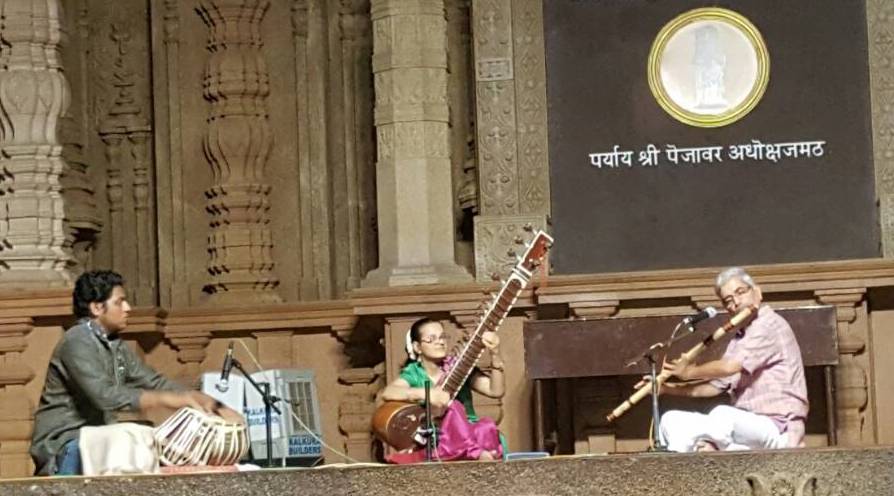
Last Friday [12th May], myself and my daughter Pratibha presented a Jugalbandi of Sitar and Bansuri at the historically important and famous 'Sree Krishna Temple' at Udupi in Karnataka.  It was a memorable day for us and a major milestone in our musical journey.


Almost about 3 years back, we never thought that either Pratibha or me will ever perform music on a stage.  After learning Sitar for few months, we have to give up her learning, as she couldn't move beyond playing plain notes, and couldn't find a teacher.  The stem cell therapy that she underwent has considerably enhanced her fine motor control and sensory integration skills along with many cognitive and behavioural improvements.  That has immensely helped Pratibha in her musical journey, by improving her: sense of rhythm; ability to grasp, ability to learn and remember musical compositions; alertness and attention span. 

After her stem cell therapy, I took the onus on me to teach Pratibha Sitar, with my limited knowledge in Hindustani Classical Music and Sitar, based on my two years of learning Sitar.  The way how Pratibha was taking interest and showing progress, has encouraged me to push her further.  Though I started learning Bansuri, hardly found quality time for practice.  Pratibha started getting stages for performance, and I focussed on preparing her for performing, as she was gaining confidence after each stage performance.   Finding a teacher to teach Pratibha Sitar was a great relief, as that helped me to start focussing on my Bansuri practice.  

"Tarang" is a music initiative that I drive, where developmentally disabled individuals sing as well as play instruments.  When we planned a one hour stage performance by Tarang members, it was decided to make it "inclusive", in order to emphasise that the developmentally disabled individuals too are part of community, just like any others.  To give an emphasis to 'inclusion' Pratibha's individual performance with Sitar was planned as a Jugalbandi with me performing Bansuri with her.  Learning, planning, practicing and performing the Jugalbandi with Pratibha was an awesome experience for me.  

This is a major milestone in our musical journey.  It was not easy for both of us. Whenever the rhythm drags, I could give clues to Pratibha through Bansuri.  We had combinations of repeating taans alternatively on Sitar and Bansuri, sharing taans by doing parts, playing Bansuri in different octave than what is played on Sitar to give better effects etc.  I was very happy to see how alert Pratibha was to wait for me to complete and then join for playing together, at the right beat on the rhythm.   Yes, there were slippages and scope for lots of improvements.  We are working on that. 

Thanks to our gurus, Smt Aparna Deodhar, Pratibha's Sitar guru and Sri Himanshu Nanda, my Bansuri Guru, for their whole-hearted support and encouragement.  

In a span of one month, we performed the Jugalbandi on three stages, two for Tarang, and the last one at the historically famous Sreekrishna temple complex, in Udupi, Karnataka.  Both of us immensely enjoyed performing.  Considering the situation 3 years back, the feeling of 'we performing together' is yet to sink in.  Yes, it is a dream come true...   

Here is the video recording of our performance in Udupi.


We discovered many areas of improvement for both of us.  We are practicing and striving to improve quality of our music.  


Sunday, January 29, 2017

Why 'Ga' and why not 'Ma'?

Couple of days back my daughter started learning raag Bhupali [called as Mohanam in Carnatic music].  She has been learning raag Durga [called Shuddha Saveri in Carnatic music] for the past 3 months.  Just to make her understand the notes of Bhupali, told her to replace the note "Ma" in Durga to "Ga" to get Bhupali.  That's when she started asking this persistent question, Why 'Ga' Bappa?  A very difficult question to answer.  Her Sitar teacher made her play the notes of Bhupali, in ascending and descending orders, for her to get comfort.  It took her few sessions to get over the 'Ma' and play 'Ga'.  

I was struggling within myself on how to make her understand the differences in raagas.  I got hold of few audios / videos of Bhupali and Durga [vocal as well as instrumental], and made her listen to them quite a few times, and get feel for the two raagas and the differences.  

According to music therapists, raag Durga is supposed to give a 'joyful' (आनंद) mood and help in dispelling depression, and ushering in positivity and in addition to renewing the energy centres in the body.  While raag Bhupali is supposed to give a feeling of 'Shant' (शांत) i.e., Serene, Quite and Peaceful.. So changing of note "Ma" to "Ga" changes the mood from आनंद to शांत.  

Now the big question in front of me is, how to measure these effects, claimed by music therapists? Want to do a small experiment, where I want to measure the effect of these two raagas on people, especially those with neudo-developmental disorders.  

Here are two hindi film songs one based on Bhupali and the other based on Durga.  One of my all time favourite song "Sayonara.. Sayonara.." from the movie 'Love in Tokyo', is based on raag Bhupali.  


The song बृंदावन का कृष्णा कनैया (by Hemant Kumar, Md Rafi and Lata Mangeshkar) from an old movie 'Miss Mary' is based on raag Durga.  The music is originally created for a Telugu song, and then used in Tamil and Hindi.  Those who have an ear for nuances in music, might be able to feel the differences - 'Ma' in place of 'Ga', leading to शांत and आनंद.  


Now let me add here two lovely short classical presentations, one vocal rendition in raag Durga and the other Bansuri rendition in raag Bhupali.  I am making my daughter listen to these many times (of course, she enjoys too 😀), leading to, she imbibing the differences, so that, on some day, it can inspire her in her playing Sitar.

Raag Durga by Sushree Anuradha Kuber.. 


Raag Bhupali by my Guru Shri Himanshu Nanda


Saturday, January 7, 2017

Surname Bemusements!

I like most things of Mumbai... The "Live and let live" attitude of people, making room for a fourth person in a 3 person seat in trains, neighbours responding positively to difficult situations, celebrating festivals together, work ethics of people, kind of freedom that children enjoy (compared to other places I saw), sense of responsibility showed by many youngsters etc. etc.. One thing that makes me uncomfortable in Mumbai is the lack of "individual" touch while addressing people.  Many people of Mumbai prefer to address others with surnames rather than by names.  When people call me "Mr Kamath" or "Mr Sreenivasa", I feel very odd and uncomfortable.  I am Rajeev, and why don't call me by my name?  Before coming to Mumbai, I worked in Bokaro, Bhilai, Visakhapatnam, and Chennai.  And I was born and brought up in Kerala.  All these years never felt such odd, because of the way people address me.  This socially vibrant Mumbai seems to have lost personal touch in this aspect..  

Picture credits:  Google search

Not many people in South India have surnames in their official records such as School Leaving Certificates, Degree Certificates etc. They face an uphill task when they apply for passports or any such document.  They struggle to discover their surnames / last names, and ultimately ends up with being called as something else.  

Picture credits: Google search

In south, for many, the house name becomes their surname.  Many communities in Kerala uses father's name as surnames.  Many don't have a surname at all; they just use initials, that indicate father's name and/ or house name.  I have seen in one community, they need just two names, to take care of any number of generations.. Mathew George's son becomes George Mathew by default.  Father's surname is George and son's surname is Mathew, and that continues for generations.  Chandy Oommen is the name of the son of former Chief Minister of Kerala Oommen Chandy!

In my case the expansion of my initials 'S' became my surname ['Sreenivasa'] in all official records, and actual surname [which should have been 'Kamath'] got lost.  I use it unofficially, only to satisfy the surname obsessed people.  To avoid further confusion, I ensured that my children do have the right surname along with their names in official records. So they have no confusion in their official records.  But, the passport office decided to change whatever was given in the application form of my daughter, and replaced it with my official 'surname'.  Have to live with it for now.  

People from south, really struggle to fill a form where they are expected to provide First Name, Middle Name and Last Name.  I know, it's a challenge for many.  In Andhra Pradesh, it's bit more complex.  Cricket legend V V S Laxman [Vangipurapu Venkata Sai Laxman] has fist name, last name and two middle names? I think, Laxman must be his name, and not surname.  Lucky guy; people call him as Mr. Laxman.  Have seen names which has even 5 or 6 parts.  

I know a person as 'Suresh N' for many years.  Got a bit of shock when heard people calling him as Mr. Nikarthil.  Absolutely no connection with his name.  Nikarthil is his house name.  

When I was working in IIT Madras, happened to meet one guy with name Namboodiripad, and this guy was from Andhra Pradesh.  As this was one of the famous surname in Kerala, I became curious.  It was surname of the first communist Chief Minister of the state.  As I was curious, asked him how did he happen to get this surname? His answer gave me a bit of shock. Seems his father was a staunch communist, and chose the surname of that communist leader for his son!  This solved another puzzle of name of a student of mine, which was Kamarajan Nehru. Kamarajan is the name of an ex. Chief Minister of Tamil Nadu, and Nehru is that of our first Prime Minister.  People have freedom to choose names [both first name and last name].  

When I was working in Bokaro, I use to talk to local people in my workplace (Bokaro Steel Plant) on their culture, lifestyle, way of life, social celebrations etc..   I remember, one staff member, whose surname was 'Prasad' telling me that he kept his son's surname as 'Choudhary'.  The reason he gave was, the surname 'Choudhary' has a better chance of getting a government jobs, at that point in time. Things might change when the boy gets to the age of 18 or 20 for him to get a job!

Because of different cultures and ways of life in India, there is no single structure for naming people. We are trying to fit that diversity into a uniform structure [which is not bad], that leads to bemusement.   

Would love to see a system, where people are addressed with their names rather than the so called surnames!


Sunday, January 1, 2017

2016 - Looking Back

Every year I use to do an introspection during the year-end period.  Thought of putting it down as a post for me to refer later.  Though I don't make any resolutions, but wanted to show some improvement in satisfaction levels in my own life, and my contributions to other's life.  I think, I'm quite satisfied on those fronts.

The year started with giving second stem cell shot to Pratibha, with a hope that her improvement would get accelerated.   The highlight of February was attending the Chinmaya Naada Bindu Fest at Kolwan Pune (CNB Fest).  I'm not able to find a word for expressing my feeling. Yes, the experience was musical, spiritual, pleasant, satisfying and very inspiring.  Meanwhile got an entry confirmed at the 'Konkani Sammelan of North America' for Pratibha to perform Sitar for 15 minutes.  Thanks to Rajesh Koppikar for making this happen.  This lead to putting focused effort on Pratibha's practice and me starting on Tabla to accompany her.  

In the month of May we participated in a press conference organised by Neurogen Hospital regarding stem cell therapy and Pratibha's progress.  The Malayala Manorama newspaper published a full page article on Pratibha highlighting her improvements. 


Coverage about Pratibha's story, on Malayala Manorama Mumbai Edition

This lead to me getting many (close to 80 to 90) phone calls from 'parents of children with special needs'., over a period of few months.  I patiently explained to them my understanding of stem cells therapy and asked them to take decision based on their own conviction.  Though it was very taxing to explain in details to each and every one of them, that gave immense satisfaction to me, as I could be of help to many such parents.  It was very satisfying to say that more than 25 - 30 of them got stem cell therapy done for their children, and are doing good.

Three weeks (end of June to beginning of July) were spent with Prashant and Kruti (Son and Daughter in Law) in the US.  Stayed for couple of days with my good old friends (Bhasy and Shyamala) in Dallas.  Our first time stay with friends.  Also met another good friend / class mate Prof. Jacob with family at Atlanta.  It was a delight to meet Venkat, another associate of mine, who worked with me at IITM many years back.  Enjoyed all the three occasions.  Felt extremely happy to be at Georgia Tech University for some time. That academic smell was intoxicating.  


Pratibha performing at the Konkani Sammelan, Atlanta, USA

14th and 15th of August this year was another musical experience at Kochi.  I could attend "Raag Rang" organised by good friend Uday. It was an opportunity to listen to day time raags, that too by young musicians Dr. Shashank Matkedar, Smt. Anuradha Kuber, Shri Mukul Kulkarni and Shri Kailas Patra. They were some of the best hindustani music concerts I have ever heard.


Performance by Anuradha Kuber at 'Raag Rang' Kochi [Photo credit: Shri Uday Shenoy]

Another major project that gave me immense satisfaction was Tarang, the music band of differently abled persons.  Driving Tarang has been an awesome experience.  We could present few major stage shows, two of them exceeded one hour.  Choosing the songs, creating musical bits to them, training the members on Sitar, Vocal, Tabla and Bongos gave me immense delight.  


Tarang Performance at Chinmaya Naada Bindu, Kolwan, Pune

Training Pratibha for preparing her perform an hour of performance was quite tedious, but very enjoyable.  Pratibha did perform at Trivandrum, in a get together of my friends, which was attended by well known Hindustani vocalist Smt Abhradita Banerjee.  A major observation was that, Pratibha could realize the mistakes and herself correct and proceed as if nothing has happened!  I consider this to be a major progress in her music journey.  


Pratibha performing at Sree Moolam Club Trivandrum on 29th November [Photo Credit: ananthapurionline.in]

Meeting students, whom I taught more than 25 years back at IIT Madras at Chennai was very nostalgic and relishing.  Another 'Aha' moment was a fabulous tabla duet by Pt Nayan Ghosh and Pt Swapan Dasgupta at the Nehru Centre on 29th December.


Tabla Duet by Pt Nayan Ghosh and Pt Swapan Dasgupta at the Nehru Centre [Photo credit: SMB Family Whatsapp group]

The top 3 of the year are:

  • Preparing Pratibha for a one hour Sitar performance
  • Working with Tarang team and preparing them to perform stage shows
  • I started saying "No", where I should.. I generally find it difficult to say "No".. 
Bottom 3:
  • Couldn't put enough time for my Bansuri practice.  [hardly any practice this year]
  • Not been reading much
  • Wanted to write more frequent blog posts. Couldn't...
Breakthrough:

      Found a right Sitar teacher for Pratibha.

Actin Plan for year 2017:
  • At least 6 visits to Chinmaya Naada Bindu this year for intense Bansuri practice
  • More blog posts... short ones..
  • Read more and spend less time on social media..
  • More music practice


Wednesday, December 28, 2016

Silent Starer to Chatterbox Sitarist

Have not written any post since August this year.  It is long time.  Many people have been asking me details about the process that went through to improve my daughter Pratibha.  When I started writing it, it is becoming longer and longer.  So first created an executive summary kind of post, and continued preparing the detailed note.  Let me publish this short post today, and in a week's time will have the longer post, for those who wanted to know the details on how we went about systematically transforming Pratibha from a Silent Starer to a Chatterbox Sitarist.

This short post is created from a PPT presentation.  


At the age of 10, when Pratibha was going to a special school in Chennai, she used to sit in the last row in the room facing the wall, as she didn't have confidence to look at people's face and communicate.


Will present the method of measurement and monitoring in the forthcoming detailed post.  

The above picture presents Pratibha's growth in last 2 years.  The PET Scan taken in August 2014 and November 2016 illustrates the increased activity levels in brain and that too with more spread.  Changes in IQ and FIM are self explanatory.


Currently Pratibha works at Arpan, a supported employment initiative by the NGO Yash Charitable Trust.  At Arpan, delicious home cooked meals are freshly prepared and delivered to customers.    


In a recent cooking competition the team of Pratibha and Aarti won 2nd prize.  The competition was judged by celebrity chef Sanjeev Kapoor and Alyona Kapoor.   A short video here demonstrates Pratibha's interest and passion in cooking.


Recently in Trivandrum, Pratibha presented a close to one hour Sitar performance.  Pratibha could perform for an hour without any strain, and that too with minimum mistakes.  Later Pratibha repeated the performance at Alappuzha TD temple too.  Then a 6 minutes performance at CETAGalaxy Global Meet at Bolgatty Palace Kochi, and a 12 minute performance at "Kochi International Book Fair".   Here's the video of the performance at CETAGalaxy Global Meet.


This post is a sneak preview of Pratibha's journey from a 'Silent Starer' to a 'Chatterbox Sitarist'.  I intent to publish the next post with details on what we did and how we did.

Request to add your feedback and comments as comments to this post, so that the post and your comments will stay together..


Sunday, August 21, 2016

Raag-Rang - A Blissful Experience..

14th and 15th August this year were two blissful days in my life.. Got an opportunity to attend a music festival Raag-Rang, organised under the banner of Shudh Kalyan at Kochi. I have attended quite a few concerts and music fests in Mumbai.  But the Raag-Rang was very special and different; organised in a city where Carnatic music rules in the classical variety; concerts in late morning through the noon to early afternoon; all artists are young and not big names; organised by my good friend Shri Uday Shenoy, who is an ardent hindustani music lover.  It was different and special in many ways.  


Invite Flier 

The Facebook posts that Uday was posting, built up the interest towards the concerts.  He even published the Samay-Chakra of raags and asked potential attendees on what raags they would like to hear.  Hindustani music being fairly strict in following the Samay-Chakra, I thought this is an opportunity for me to listen live some of my favourite raags such as Bhimplasi, Saarangs [Shudh, Gaud and Brindavani], Bhairavi, Alahiya Bilawal, and some of the lesser heard raags such as Ramkali, Multani and Jaunpuri.  Foremost, wanted to be part of the Shudh-Kalyan initiative, and enjoy the music.  I was sure that Uday must have done his homework well in selection of artists, selection of venue [for the right ambience] and overall organisation of the fest.  

The fest opened with young Dr. Shashank Maktedar, disciple of Pt Ulhas Khashalkar.  I have heard couple of concerts by Pt Ulhasji live.  Panditji's influence was visible in Shashank's rendering, but with his own individuality.  Shashank presented raags Ramkali, Hindol Bahar, Alhaiya Bilawal and Basant Mukhari.  Raag Ramkali always reminds me the compositions performed in Sikh Gurudwaras, majority of them being in raag Ramkali.  Thoroughly enjoyed everything that Shahank presented.  To me what stood out was rendition of Hindol Bahar.  It was awesome.  Dr. Ravindra Katoti's harmonium accompaniment was subtle but exceptional.  Well controlled tabla support by Dr. Udayraj Karpur created the right vibrations.  I had experiences of listening to excellent vocal artists, where accompanying artist's eagerness to overpower the main artist spoils the 'music' of the concert.   Here in Raag-Rang, both the accompanying artists were mature, controlled and accompanied the main artists, focussing on sense of 'music'.  Overall, the right musical vibrations were set by the first concert.


Dr. Shashank Maktedar, Dr. Ravindra Katoti on Harmonium and Dr. Udayrak Karpur on Tabla

It was close to noon when the concert was over.  Yummy bonda, pazham-pori (banana fry) made in typical kerala-konkani style, and tea with right sweetness, filled the stomach right, so that we are set for another musical treat.  

The next performance was by Smt Anuradha Kuber, disciple of Pt TD Janorikar and Dr. Arvind Thatte.  She is an exponent in Bhendi Bazar Gharana.  Listening to female voice after a concert by male artist provided a contrast, that made the concert sweeter.  It was the Saarang time.  Saarang means 'spotted deer', one of the most beautiful animals in nature.  Saarangs are very close to my heart as I lived in IIT Madras campus for 15 years; the campus is full of Saarang deers. Anuradha Kuber presented both Shudh Saarang and Gaud Saarang, that took me to the zig-zag movements and jumping of spotted deers, that we use to enjoy every day.  Usage of both (Shudh and Tivr) Madhyams is one of the aspect that make the raag very melodious.  Both were superbly presented.   A short & sweet composition in Multani did create a 'restless' feeling.  The swar-jati she rendered stands out.  The composition on 'holi' she sang in Hori, painted the picture of Krishna playing rang-holi with gopikas.  The climax was superb with a tarana in Bhairavi.  I have heard Bhairavi in evening concerts many times.  But listening Bhairavi in the right prahar, does make a difference.  Again, the matching accompaniments by Drs Katoti and Karpur were exceptional. 

Smt. Anuradha Kuber, Dr. Ravindra Katoti on Harmonium and Dr. Udayrak Karpur on Tabla

True to the Indian hospitality tradition, all attendees were served with a delicious lunch, which was a surprise to all of us.  Uday was mentioning it as simple lunch.  Uday, it is not the number of items that matter, but the thought behind it.  

The second day started with a vocal recital by Shri Mukul Kulkarni, disciple of Pt Arun Khashalkar and Pt Sharad Sathe.  Mukul sings in Agra-Gwalior Gharana style.   I could feel the influence of Pt Arun Khashalkar's style of rendering in Mukul's presentation.  Mukul chose to start the performance with Miya ki Todi, with a traditional bandish.  Though Miya ki Todi is considered to be a raaga that sets a pensive mournful mood, but Mukul's rendering set a positive vibrant mood that characterises festivity.  I was generally considering Agra gharana singing to be a bit dry; but Mukul's rendition is forcing me to make amends to my original considerations.  Mukul followed bibhas with a composition in raag Pancham.  I think, this is the first time I was hearing raag Pancham.  A Tukaram abhang that Mukul presented was awesome.  Was very happy to see a maestro in the making.  

Mukul Kulkarni, Dr. Ravindra Katoti on Harmonium, Dr. Udayraj Karpur on Tabla and Swetha Bhakta on Tanpura
As with the previous concerts, Dr. Ravindra Katoti's harmonium and Dr. Udayraj Karpur's tabla gave the right support to Mukul's vocal rendering.  Hot tea with udad and dal vadas set a cheerful mood for all attendees. 

The finale was violin concert by Shri Kailas Patra, disciple of Pt SR Kulkarni, Pt LK Pandit and Pt DK Datar.  It was a very different kind of performance.  Previously I have heard violin hindustani recitals of Dr. TN Rajam and Shri MS Gopalakrishnan, during Madras Music Festivals. Shri Patra's performance was of a very different genre.  His control over the instrument was impeccable.  Shri Patra presented Gaud Saarang and Barwa. The zig-zag melodic movements of Gaud Saarang were beautifully brought out by Patraji.   His singing the lyrics of the compositions helped the audience to enjoy the rendition better.  The high-vibrancy performance of Patraji was fitting finale for Raag-Rang.  Unable to pin-point a highlight in the performance, as from beginning to the end, all stood out.   It was very thoughtful by Uday to keep this violin performance at the end, as not only it gave a sense of climax for the fest, but other concerts would have got subdued.  It was heartening to see Patraji praising Dr Udayraj Karpur for excellent tabla accompaniment.  This doesn't happen often. 

Shri Kailas Patra on Violin, Dr. Udayraj Karpur on Tabla and Swetha Bhakta on Tanpura
As on previous day, after a simple but delicious lunch, we all went back with lovely memories of exceptional quality hindustani music.  The independence day was well spent, fully getting submerged in our cultural heritage, that too in a right ambience of Kerala Kathakali Centre at Fort Kochi.  

No words to express the joy and delight that I went through in these two days, while listening to the concerts.  Felt very happy that the future of Indian Classical Music is very bright, after seeing the performances by younger generation.  

Finally a BIG Thank You to Uday, who single handedly went ahead with organising Raag-Rang, and made it a big success.  Also "Thank you" to all those who have worked hard with Uday to make Raag-Rang a reality and success.   The success of a classical music performance is not based on the size of the audience, but the quality of the audience.  

Did I miss anything? Yes, I missed raag Bhimplasi, a raag in the right prahars of the concerts in Raag-Rang.  I did expect to hear Bhimplasi.  Have not heard this raag so far in a live music concert.. 

Yes, those 2 days were blissful days..  Fully immersed in music..  Never thought I will be part of such a musical treat in Kochi..   The first ever hindustani music concert I happened to attend was in Kochi, which was by Smt. Lakshmi Shankar, way back in late 1960s.  I don't want to make the circle complete now.  Want to be part of many more Raag-Rangs in Kochi.  

Will cherish the memories of the two blissful days... 


From Muladhara to Kailasam: A Journey Within the Shiva Lingam

  Our Visit to the Maheswaram Sri Shiva Parvathi Temple, Chenkal Some temple visits stay with us because of the deity, some because of the a...