It is 7th day today of my Autism Acceptance campaign.As indicated earlier, the first step in acceptance is awareness.Autism is complex to understand.It is a spectrum disorder and thus each autistic person is unique.There would be some common traits in behaviour, interactions etc., still each person is different and unique.For common people to understand this aspect, especially “spectrum disorder” is not easy.Hence taking the analogy shown in the poster.
Autism .. It’s not a processing error.. It’s a different Operating System..
It is a very good analogy to understand Autism better.Majority of us are comfortable using Windows Operating systems, and will find it difficult to use a different operating system such as Mac OS or Linux.In Linux too there are many flavours / variants.Redhat, Ubuntu, Fedora, Debian etc. are some of the variants of Linux operating system.All these have the same basic concepts manifested differently, as in a spectrum.The common traits of Autism such as poor social communication; repetitive, odd or stereotypic behaviours; prefer to play alone; poor eye contact etc. are manifested differently with different degree of intensity in different autistic individuals.
Processing error happens for neurotypical (the so called ‘normal’) as well as for autistic persons. Then don’t consider Autism itself as a processing error.
Take away here is, Autism is not manifestation of any mistake or error, but it is just being different, because of neurodevelopment disorder.Let us try to understand them by observing them, and try to communicate with them the way they understand the world, and lead to a better acceptance and inclusion.
I have been doing music therapy for autistic persons for past few years.The way each person perceives, understands and responds is very different.I have to communicate differently with each person.For the same action, command in different operating systems are different, and I have to figure out and discover the appropriate command for communicating with each person.This is very different from dealing with neurotypical (the so called ‘normal’) persons.
Let us try to learn more operating systems to be comfortable in this inclusive world!
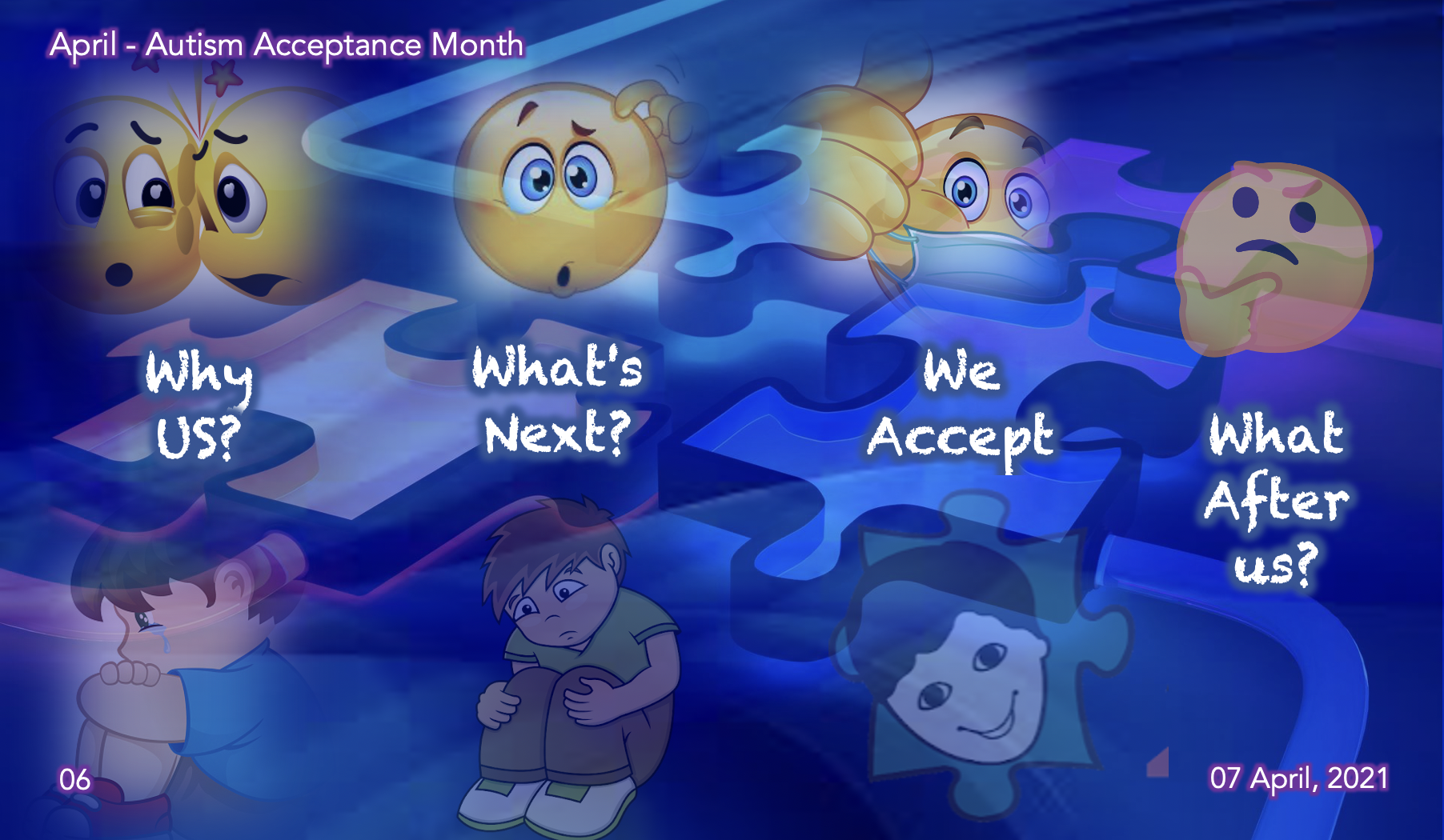
Today it is 6th day of my Autism Acceptance campaign and we will look at different stages the families go through..
First many questions go through parents’ minds.“Why us?”..“What wrong we have done?” “Why God is punishing us?” etc. etc. The community around including extended family tries to find fault with parents. It takes time for parents to come out of this stage of “Why Us”?Strong support by family and community around only can reduce the duration of this phase.Stronger parent comes out of this stage first.When the mindset of parents and other family members is “Why us”, they become blind, and lose the focus on the child’s development and growth.Precious time is lost, leading to delays in getting the right interventions.Because of neuroplasticity property of the brain, as the time progresses, the ability of brain to change tapers off.It is very essential for parents and families to come out of “Why us” stage at the earliest.
Once the parents and family members come out of the “Why us” mindset, the next question is “What next?”.Precious time is lost, and parents start running around and unable to decide what to do next.This is when parents approach doctors, therapists, psychologists etc. in a random manner.. Also many alternate medicines / therapies are tried out, mostly in a haphazard manner.Many go to astrologers and religious persons too.Objective is to do whatever that can bring the child back to “Normal”.
Generally It takes many years for most parents and families to reach the “Acceptance” state.Once they reach this stage, the child starts blooming.The child starts getting unconditional love and support from family.Parents keep thinking about identifying the best in the child and nurturing that.The unconditional love towards the child starts making all the difference, leading to the child start seeing happiness and joy. I had conversions with many parents, where they want to know what all we did for our daughter.Majority of the parents starts the conversation with “my child has mild problem”.Recently a 24 year old autistic person’s mother was telling me that her son has only 1% autism.Another parent of a 29 year old, was refusing to accept that her son has autism.Later I came to know that the issue is because of social compulsions.I consider these as symptoms of lack of acceptance.‘Family with an autistic child’ is still ‘untouchable’/ ‘taboo’ in our society.
As the parents grow and time progresses, the next big question in the minds of parents is “What after us”?The autism fraternity, parents groups and NGOs are working hard to find solutions to this question.There are businessmen too who tries to exploit such conditions. Quite a few autism villages are coming up in the country as solution to this worrying question.
Based on my learnings, my request to parents is to “Accept your child as it is”, “Give unconditional love”, “Identify what the child is best at”, “Pursue what the child is best at”, “Work with other parents to find solutions for the child’s future”..
Spreading awareness is thefirst step towards the goal “Acceptance”.Parent bodies, NGOs and some ofthe governmentestablishmentsdo their bit to spreadawareness on autism.One of the symbolic actsbeing done is to light upiconic landmarks across theworld in blue on 2nd April, theAutism AwarenessDay.
Today on 5th dayof Autism Acceptancecampaign, I thoughtof bringing outthis lighting of landmarks in ourcountry as well as inthe world.Many participatinglandmarks show their support forthe initiative by keeping thelights on throughout themonth of April.
Sad to see that, eventhese efforts don’tresult in spreading of awareness.People look at the beauty of thelandmarks in ‘blue’ and say“Wow” and for most it stopsthere.Trying to touchthe lives of fewautistic people andcontributing a bit to makethis world an inclusive onehardly happen.
Today on 4th day of Autism Awarenesscampaign, I am highlighting some issues thatautistic peopleand families continue to face.
They get sociallyisolated.
They are being judged as ‘strange’.
They hear disapproving noises.
They are asked to leave from public spaces.
They have lost friends!
This happens throughoutthe world.But, the degree andintensity varies from placeto place depending on howaware people are and how muchpeople accept differentlyborn ones.The numbers shownin the poster are froma study conducted in thewest.We ourselveshave faced many ofthese situations.
Acceptance by the societyis the only way to address theseissues.Let us hope that thingswill start changing…
Today, on 3rd day of AutismAcceptance campaign,I am bringing out another lesser known aspect in families havingan autistic child.The poster speaks for itself.
“I wish to live in a world whereacceptance is not just thegoal, but the reality. I want to live in a worldwhere someone talking inthe deficit model ofawareness is regarded asuncomfortably out of touchwith how things should be.This is my world too, and I wantit to be filled with people whoknow that Iam autisticand fantastic, not that I“have autism” and that istragic. In my ideal world,flapping will be just as acceptable as smiling,earplugs will be a normal sight,AAC devices (Augmentative and Alternative Communicationdevices) will be commonandeveryone willknow how to converse with AACusers. In that world,neuro-diversity will bejust another way that people are unique,and everyone will agree thatdiversity is part of what makesthe world so beautiful”.
This is from a blog post of Kassiane S, an autistic rights activist,who herself is autistic. Kassiane was improperly diagnosed before discovering the autismspectrum at the age of 18.The words come from the heart.That’s what we want to achieve tomake the world so beautiful.
All along, the month of April is being celebrated as World Autism Awareness day.United Nations has declared April 2021 as the month of Autism Acceptance.Yes, awareness is the first step towards acceptance.Why is it critical now to have this shift?In United States of America, prevalence of Autism has risen from1 in 125 children in 2010 to 1 in 54 in 2020.The prevalence could be more or less similar in our countrytoo, may be with few percentage difference here andthere.
People with differences are born different.Are they not equal citizens of this world?The way the worldevolved, and the way the majority in this world lookat people who are ‘different’ is sad.Come on, letus accept them as part of our society.Not just lip service, but be part of the movement.
It is a fact that,unless there is someone affectedin the family, “why should I”attitude prevails.First be AWARE ofthe ‘difference’ and then ACCEPTit as part of societyand be part of the process thatenables ‘inclusion’.
Awareness is easy, but acceptance requires hard work.
Acceptance and awareness comes from vastly different mindsets.
Those who are aware “Tolerate”,but those who accept “Embrace”.
Becoming awareness is more or less one time thing.But acceptance is a continuous process.
Awareness and acceptance canbecome reality, only wheneveryone interactwith the ‘different’ ones and understandhow they react to situationsand how they lead their life.In spite of knowing aboutopportunities, not manyare willing to get to knowabout the ‘different’ ones.That’s thesad state of affairs in ourworld.
Humble request..We vociferously discuss‘political differences’ and‘religious differences’.. We don’t even missan opportunity to judge /accuse even friends whothink different politically and do differentreligious practices.Why don’t we find some time to thinkabout people who are borndifferent and struggle tolive in this world, make use ofopportunities to interactwith them and accept them aspart of this beautiful, diverse and inclusiveworld.
[Most of these quotes are taken from Kassiane’s post].
Navratri days were always colourful.It was very special festival for us in family.During childhood, we use to have special decorations and pujas every day at home with tasty Naivedyams / Prasads.Over the period of time all the decorations got reduced, puja and Naivedyams remained, and more music got added.We use to sing bhajans every day evening, which was led by my mother. These days, the music got confined only to the Vijayadasami day, after the Saraswati puja.
This year it was very different.Lockdown days dampened the spirits of Navratri in general.Just a day before start of Navratri, Pratibha’s Sitar guru Smt Aparna Deodhar suggested that why not do a video series in which Pratibha and the guru perform together one raag a day.To include only the compositions and not improvisations.I got excited with the suggestion and did not realise the challenges ahead.We finalised the raags for each day. Teacher also suggested that let Pratibha wear Saree during the performance.These were sufficient for Pratibha to get excited, playing along with her guru, that too wearing saree. She loves wearing saree and these days not many opportunities for wearing saree.Wow! We all got excited.Awesome way to bring colours of Navratri back.So, it is going to be Navratri Navrang this year.
We all got into preparation to make the Navrang a reality.Some of the raags Pratibha learnt more than 3 years back, and she has not practiced them at all.We have setup a process.First make Pratibha revise the compositions in the chosen raag of the day.Once we get comfort with her playing, do the video shooting, of course Pratibha wearing saree.Once the shooting is over, edit it to remove all unnecessary takes and send the video to the teacher.Teacher listens to it and plays the same what Pratibha has played and sends her video to us. During that time, I get into creating a cover design for the video.Then sync both the videos, adjust the volume levels, place the videos side by side etc. to create the final one.Send the final video to the teacher, who posts it on the Facebook, and we share it on our Facebook timelines also to a few friends and groups in WhatsApp.This was the process we followed.I was spending a minimum of 6 hours a day for all my tasks.Most of the time was spent in two tasks, (1) revising the compositions that Pratibha has to play & then making Pratibha practice and (2) video editing.
After watching for couple of days’ videos, one of my friend commented that playing along Pratibha is a bigger challenge for the guru, as Pratibha has problems with rhythm and she misses beats once in a while and the tempo varies while playing, though less often. Matching that is not an easy task!!Such amazing support from a Guru, matching Pratibha’s ‘playing’ (with rough edges) is something which gave real “colour” to this Navrang series.I am sure, this is because of the bond that Pratibha and her guru share.
My wife Asha was giving all the support and encouragement.The biggest task for Asha was selecting sarees for each day, making Pratibha wear saree and all the associated accessories, and reviewing the videos in progress.Pratibha’s excitement was for two reasons: (1) Playing along with her guru (in video), and (2) opportunity to wear saree.After couple of days we realised about the colours associated with each day of Navratri, and decided to make Pratibha wear saree having the colour of the day.
It was a thoroughly enjoyable Navratri for us, for me fully engaged in music and video creation.The commitment by Pratibha's guru Smt Aparna Deodhar has to be appreciated, as she was there for any help all the time.For me it was a laborious task, but I enjoyed thoroughly.From us, myself, Asha and Pratibha, a big thank you to Aparnaji for making the suggestion for the video series and supporting it all through the nine days.
The response we got for these videos from social media were very encouraging. Here are the nine videos and at the end a link to the playlist, where all the videos can be viewed.
Day 1: Raag Bairagi
Raag Bairagi is also known as 'Bairagi Bhairav'. The equivalent ragam in Carnatic music isRevati. The time associated with this raag is morning 6 AM to 9 AM. This raag is supposed to evoke karunarasa. It is to be noted that many of the vedic verses and shlokas are chanted in this raag. It is said that the steep fall from Madhyam to komal Rishabh adds to the poignancy of the raag Bairagi.
Day 2: Raag Shivranjani
Shivranjani is a melodious raag and gathers strength from sadness. This raag is very similar to raag Bhoopali with just one note different, i.e. komal Gandhar instead of shudh Gandhar. Though the difference is very small, the mood the two raags create are very different. Shivranjani is considered to be a raag borrowed from Carnatic music. The time associated with this raag is midnight. Bollywood has used this raag for many popular songs that reflects sad mood. One example is "Jane kahan gaye wo din.." from the film Mera Naam Joker..
Day 3: Raag Hamsadhwani
In Hindustani music style, raag Hansdhwani is considered to be borrowed into it from Carnatic music. Time associated with Hamsadhwani raag is 2nd prahar of night. Hamsadhwani is a bright and happy raag setting a vibrant context for a concert.
Day 4: Raag Bhoopali
Raag Bhoopali, also called Bhoop, is a very popular raag. The equivalent of this in Carnatic music is ragam Mohanam. The time prescribed for this raag is again 6 pm to 9 pm, the first prahar of night. Bhoopali is a tranquil soft melody that fills up a new life force in the atmosphere.
Day 5: Raag Yaman
This raag is considered to be one of the most fundamental raags in Hindistani tradition. Kalyani is the equivalent ragam in Carnatic music. The time associated with this raag is first prahar of night, i.e. 6 pm to 9 pm. Yaman is full of grace and beauty, evoking a mood of devotion and dedication.
Day 6: Raag Malkauns
Malkauns is one of the oldest ragas of Indian classical music. The equivalent raaga in Carnatic music is Hindolam. The raag is said to have evolved when lord Shiva performed the Tandava dance. The raag thus evokes a feeling of vigour or Veer rasa. The time associated with this raag is 3rd prahar of the night, i.e. 12 midnight to 3 am.
Day 7: Raag Durga
This year, the seventh day of Navratri was considered as Durgashtami, hence we chose the raag Durga for this day. The traditional emotion associated with raag Durga is boldness and determination. It also signifies purity. The time associated with this raag is 2nd prahar, viz. 9 pm to 12 midnight. Suddha Saveri raag in Carnatic music is considered to be very close to Durga in terms of notes, but the way these ragas are rendered are quite different in both styles of music.
Day 8: Raag Bhimpalasi
Bhimpalasi is a very sweet and hauntingly pleasant melody. This raag is supposed to depict the sringara rasa (romantic mood). The time associated with this raag is 12 noon to 3 pm. The Carnatic music equivalent of this raag is Karnataka Devagandhari. Dhanashri ragam is also very close to Bhimpalasi.
Day 9: Raagsagar
Navratri Navrang was concluded with a raagsagar (raagamaalika), rendering multiple raags in one composition. The five raags are Kalavati, Rageshri, Chandranandan, Malayamarutham and Bhairavi. Kalavati and Bhairavi are very popular raags. Raag Bhairavi is called queen of melodies, which is known as Sindhubhairavi in Carnatic music. Though raag Bhairavi is an early morning raag, it is popularly used as a concluding piece in the concerts at any time. We are also concluding Navratri Navrang with Bhairavi, but followed by a short jhala in Kalavati.
Here is link to a playlist of all the nine videos.